
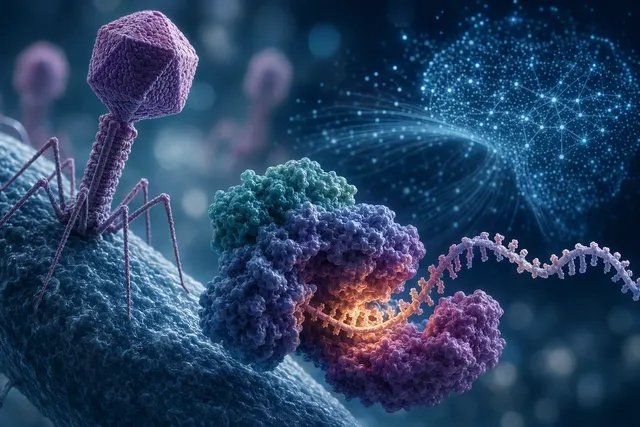
Washington. Artificial intelligence company Anthropic has claimed that its AI model Claude has identified a potentially unique biological mechanism in the bacteriophage virus. The company has named this new system ‘Art’ i.e. ‘Array Associated Reverse Transcriptase’ (ART). Some features of this system are said to be similar to the famous gene editing tool ‘Crisper’. However, it is yet to be proven whether this system is actually fully capable of gene editing or not.
950 AI agents and 21 hours of analysis
According to Anthropic, Claude performed a thorough analysis of the genetic sequences present in viruses that infect bacteria and identified an unusual pattern. This complex process involved approximately 950 AI agents screening more than two lakh reverse transcriptase enzymes. After this analysis that lasted for about 21 hours, a possible candidate emerged, which is considered very important for further scientific studies.
Danish researcher expressed objection
After this claim came to light, Mario Rodriguez Mestre, a researcher at Copenhagen University in Denmark, has raised questions on it. He says that his team had been working on this biological system for years. According to Mestre, he had used Cloud extensively during his doctoral research and also shared some unpublished research material with the AI. In such a situation, he raised the question whether this discovery of Anthropic was completely independent or had any influence on the information shared by him.
Company’s clarification and peer-review pending
Anthropic responded to this objection by saying that its model does not train on data from user interactions. According to the company, AI agents only help in finding patterns in scientific databases and forming hypotheses. At present, this research has not been published in any peer-reviewed scientific journal and has yet to be independently scientifically confirmed, so it is too early to consider it a proven biological discovery.